Achieved at : 2026-04-11
Rank : 2
(46% worse)
Lups : t.b.d.
Approved :
No
Vote progress : 40%
| General Rules: |
Play with default settings unless otherwise specified. No use of trainers, cheats, saved game files, auto-fire (when not default present in-game), emulator save states, or other emulator advantages. No use of code modifications that give the player an advantage over other players. 1 player only. No continues. It is discouraged and may lead to voters not accepting your score to - excessively point farm - use glitches or other game exploits |
| Specific Rules: | Play the game in Original mode with Difficulty = Easy. |
To vote or comment on this score, please
login.


TGP
Columns is a tile-matching game for the Sega Master System. The Master System version was written by Sega and occupies a 1-megabit cartridge (128 KB) as it is a relatively small game. It was released in 1990. The original game was written by Jay Geertsen in 1989 for the Hewlett Packard HP 9000, a workstation system running a UNIX based OS.
Sometimes referred to as Sega's answer to the success of Tetris on the Nintendo, Columns has a slightly different mechanic where the aim is not to create full rows, but groups of three or more of the same tile type. Columns of three tiles drop from the top of the screen and the player can switch the order of the tiles or move the column left or right. Unlike Tetris, the player cannot rotate the column. If groups are created they disappear, scoring points and making more room on the screen. The larger the groups created, the more points are scored. If the Columns reach the top of the screen it is game over. The game speeds up over time as blocks are cleared. Occasionally a "Magic Column" will appear which removes all tiles of the type it lands on.
The game features a selection of tile designs (useful if you find some types difficult to see) and a number of gameplay modes and difficulty options. So while the basic gameplay remains the same, there is a fair amount of longevity here. It also works well as a casual game, and in that regard it is timeless, in the same way that Tetris is. The game's graphics are ok, but they could have been better - the Master System is capable of more (perhaps a little larger would have been nice) - and sound is of the usual Master System standard. The game controls well and is entertaining. A solid, though not quite outstanding, classic of the Master System library.
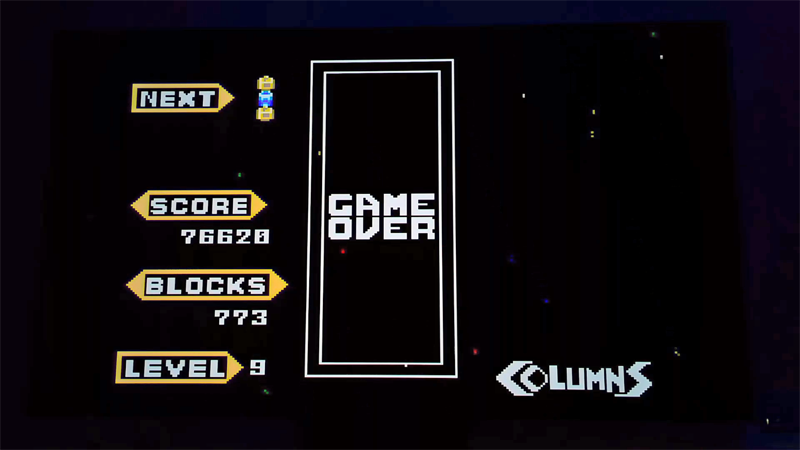
This game was played using a Heber MiSTer Multisystem 2 with the Sega Master System core. Game settings were Original / Difficulty Easy / Starting Level 0. The final score was 76,620 points, with 773 blocks cleared.
If you want to know more about the Multisystem 2, look here:
https://multisystem.uk/
Time stamps:
00:30 Title screen.
00:33 Game type and difficulty options selection.
00:46 Game start.
02:00 Level 1 reached.
03:22 Level 2 reached.
05:05 Level 3 reached.
06:45 Level 4 reached.
07:54 Level 5 reached.
09:12 Level 6 reached.
09:15 Magic Column.
10:05 Level 7 reached.
10:51 Level 8 reached.
11:28 Level 9 reached. This is the highest level and no further increases occur.
15:18 Columns reach the top of the screen. Game Over! Final score 76,620 points and 773 blocks.
Sometimes referred to as Sega's answer to the success of Tetris on the Nintendo, Columns has a slightly different mechanic where the aim is not to create full rows, but groups of three or more of the same tile type. Columns of three tiles drop from the top of the screen and the player can switch the order of the tiles or move the column left or right. Unlike Tetris, the player cannot rotate the column. If groups are created they disappear, scoring points and making more room on the screen. The larger the groups created, the more points are scored. If the Columns reach the top of the screen it is game over. The game speeds up over time as blocks are cleared. Occasionally a "Magic Column" will appear which removes all tiles of the type it lands on.
The game features a selection of tile designs (useful if you find some types difficult to see) and a number of gameplay modes and difficulty options. So while the basic gameplay remains the same, there is a fair amount of longevity here. It also works well as a casual game, and in that regard it is timeless, in the same way that Tetris is. The game's graphics are ok, but they could have been better - the Master System is capable of more (perhaps a little larger would have been nice) - and sound is of the usual Master System standard. The game controls well and is entertaining. A solid, though not quite outstanding, classic of the Master System library.
This game was played using a Heber MiSTer Multisystem 2 with the Sega Master System core. Game settings were Original / Difficulty Easy / Starting Level 0. The final score was 76,620 points, with 773 blocks cleared.
If you want to know more about the Multisystem 2, look here:
https://multisystem.uk/
Time stamps:
00:30 Title screen.
00:33 Game type and difficulty options selection.
00:46 Game start.
02:00 Level 1 reached.
03:22 Level 2 reached.
05:05 Level 3 reached.
06:45 Level 4 reached.
07:54 Level 5 reached.
09:12 Level 6 reached.
09:15 Magic Column.
10:05 Level 7 reached.
10:51 Level 8 reached.
11:28 Level 9 reached. This is the highest level and no further increases occur.
15:18 Columns reach the top of the screen. Game Over! Final score 76,620 points and 773 blocks.